
Contact Us Now

After working with oil producers for years, I’ve lost count of how many times this question came up. And honestly, it always leads back to the same simple truth – the way you extract oil changes everything. Not just how much you get out of each seed, but how your product tastes, how it performs, and how people see your brand.
At GQ-Agri, I’ve watched this play out in real plants, not just on paper. Every setup tells its own story – some push for volume, others chase purity. When my clients asks, “Which extraction route really fits my seeds and my goals?” I usually start from here: there are only two main paths. One works through solvents that dissolve oil out of crushed seeds. The other does it the natural way by pressure and precision.
Both can succeed when done right. But if your focus is cleaner oil, simpler operation, and steadier quality, mechanical pressing tends to hold up best over time. That’s why most of the systems we build are designed around it – practical, safe, and built to last.
What Are the Two Main Methods for Edible Oil Extraction?
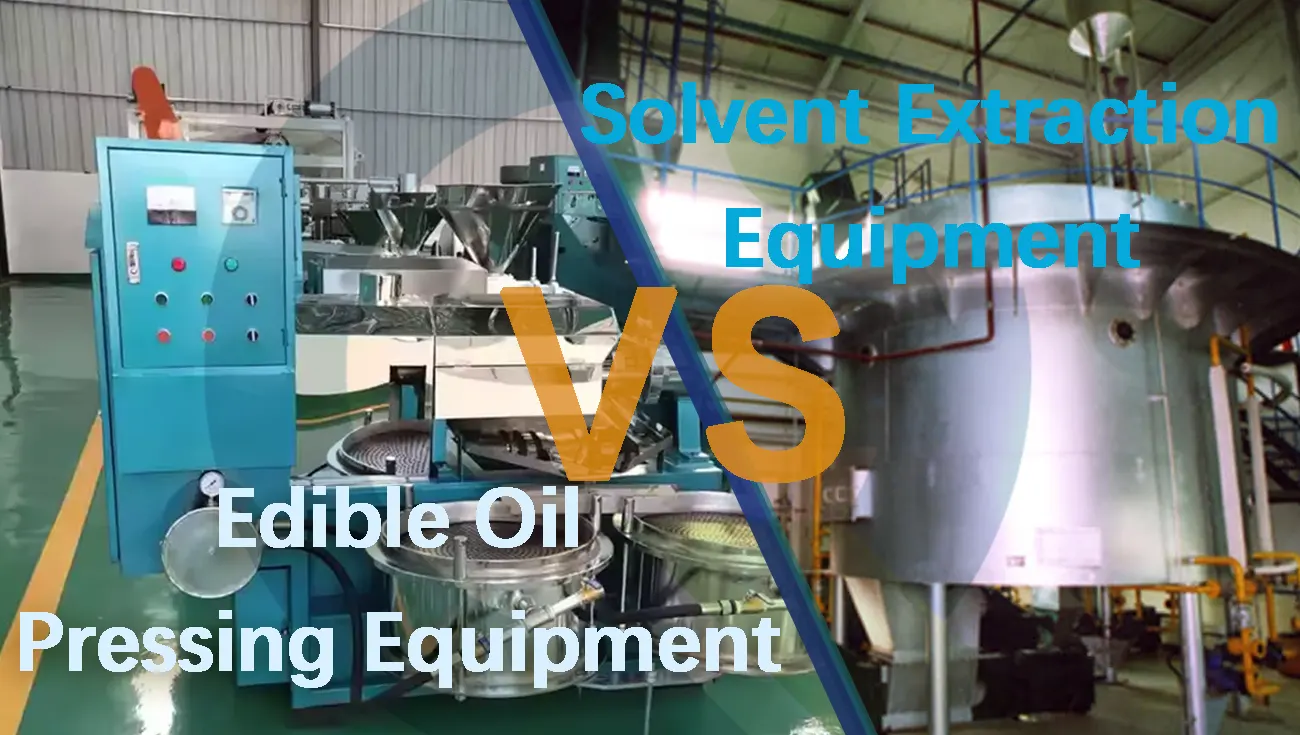
Ask anyone who’s ever worked around oil mills, and they’ll tell you there are really only two ways to get oil out of seeds: mechanical pressing and solvent extraction. Everything else is just a variation of those two ideas. The choice between them shapes not just your yield, but your plant layout, cost, and even how customers think about your product.
Put simply, a solvent-based process depends on chemicals like hexane to dissolve oil from seed flakes, delivering high extraction efficiency at industrial scale. Mechanical pressing does the same job by force rather than chemistry. The oil comes out under pressure – no solvents, fewer controls, and a cleaner footprint. That straightforward setup is what many smaller or high-end producers prefer.
| Method Category | Core Principle | Typical Use Case |
|---|---|---|
| Solvent-Based Extraction | Using a chemical solvent to dissolve oil from pretreated seed material | Industrial scaling, high yield operations |
| Mechanical / Physical Pressing | Applying mechanical force (pressure or friction) to squeeze oil out | Small-to-medium scale, premium/clean label oils |
Both work, but they reflect very different ways of thinking. One trusts chemistry to do the heavy lifting; and the other depends on precision machines and patience.
Solvent-Based Extraction (Leaching / Chemical Extraction).
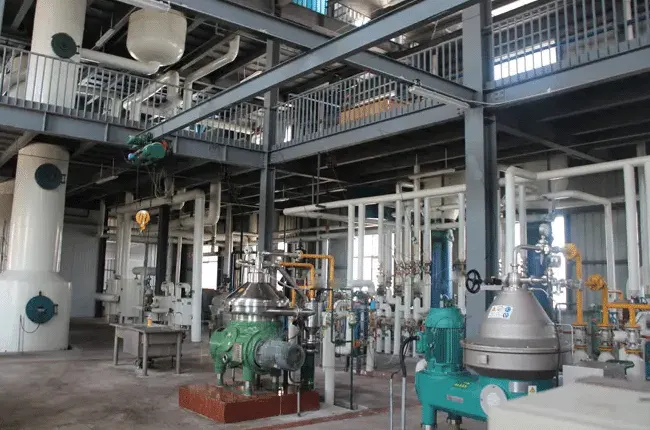
In big edible oil factories, solvent extraction is the backbone process. Seeds are first flaked or crushed to open their cells, then soaked or percolated with a solvent, most often hexane, that dissolves the oil. The liquid mixture, known as miscella, goes through heating and condensation stages so the solvent can evaporate, be recovered, and reused. What’s left behind is crude oil ready for refining.
When done right, the recovery rate is excellent. You can get the residual oil in the meal down to below 1 %, which adds up fast when you’re processing hundreds of tons a day. That’s the main reason solvent plants dominate large operations.
But there’s a flip side. These systems are so complicated: solvent recovery towers, desolventizers, emission control and strict safety measures all come into play. Even trace residues must meet food-grade limits and keeping the process stable demands skilled operators. Add the energy bills and it’s very easy to see why only large plants can justify the investment.
A practical middle ground some companies use is pre-pressing before extraction. The press removes a portion of the oil and the solvent system finishes the rest, so that you can save some energy and reduce solvent load without losing much yield – a common compromise in mid-size setups.
Mechanical / Physical Pressing.
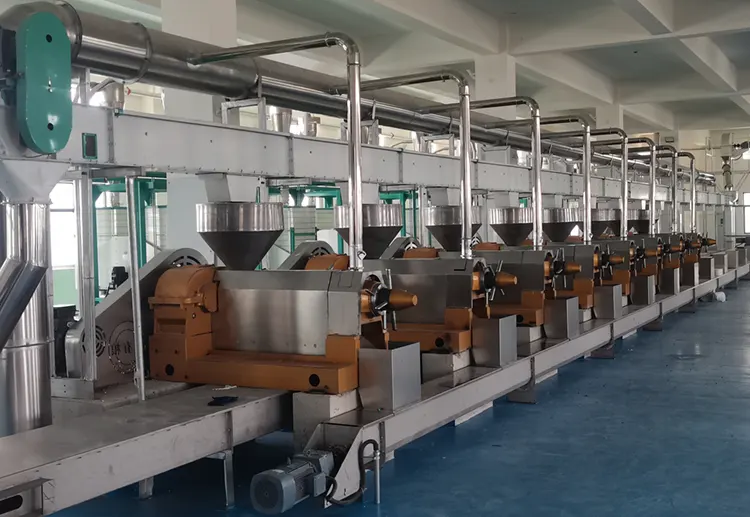
Now, let’s talk about another way. Mechanical pressing is the straightforward and hands-on approach that’s been around forever. You feed pretreated seeds into a screw or hydraulic press, apply pressure, and watch the oil flow out. No solvents, no chemical recovery, no explosion-proof rooms, just physics.
For smaller producers or premium brands, this route makes a lot of sense. It’s safer and easier to control, and fits perfectly with “natural,” “cold-pressed,” or “solvent-free” labels. The setup costs less and maintenance can often be done by the team on site. About the trade-off? You’ll leave a few percent of oil in the cake, usually around 3 – 5 %. Still, for many, that’s a fair price for a cleaner process and better-tasting oil.
With good equipment design, like GQ-Agri’s precision screw and hydraulic press systems, you can fine-tune pressure and temperature so the oil keeps its aroma, antioxidants and bright color. It’s not just about yield, and it’s about producing an oil you’re proud to bottle.
Based on my industry experience over the past decade, I’ve compiled a simplified comparison to help you make a decision:
| Feature | Solvent Extraction | Mechanical Pressing |
|---|---|---|
| Oil Residual in Cake | Very low (<1 %) | Higher (few % to 3–5 %) |
| Complexity & CAPEX | High | Moderate to low |
| Operational Risk / Safety | Higher (flammable solvents, emissions) | Lower |
| Suitability | Large-scale or medium scale | Small to medium, specialty producers |
| Oil Quality (flavor or aroma) | Needs refining, possible degradation | More natural preservation |
Choosing between these two methods isn’t just about getting the most oil out. It’s about what kind of business you want to run. Solvent extraction is unbeatable for sheer volume, but it ties you to bigger budgets, stricter permits or more oversight. Mechanical pressing may leave a bit of oil behind, but it gives you control, simplicity and a cleaner story to tell your customers, and that’s where GQ-Agri’s integrated pressing systems are designed to help.
What Is the Difference Between Leaching and Mechanical Methods?
At its core, the difference between leaching and mechanical pressing comes down to how you separate oil from the seed-chemistry versus physics. Solvent extraction relies on chemical solvents to dissolve oil and pull it out completely, while mechanical methods simply press the oil out under force. And the trade-off is clear: leaching gives you slightly higher yield, but pressing gives you cleaner oil, simpler systems and a safer working environment.
When I talk with clients or fellow mill owners, this is always the turning point in our discussion, because the method you choose defines your cost structure, product identity, and even how customers perceive your brand. Here’s how I usually break it down so it’s easy to visualize the difference.
| Factor | Leaching / Solvent Methods | Mechanical / Pressing Methods |
|---|---|---|
| Oil Yield & Residual Oil | Very high recovery. In many solvent plants, residual oil in the cake drops below 1%. | Lower recovery. Some oil remains in the cake; residual may reach several percent. |
| Quality, Aroma & Nutrients | Needs careful refining; some volatile or delicate compounds may be lost or altered. | More “natural” retention of flavor, aroma, antioxidants. Pressed oils often taste more like the seed itself. |
| Capital & Complexity | High: solvent recovery, distillation, safety systems, ventilation, double sealing, regulatory compliance. | Lower: relatively simpler mechanical systems, less demanding on safety controls (though still requiring care). |
| Operational Overheads & Risk | You run risks around solvent leaks, emissions, explosion hazards, and costs of energy for recovery. | Simpler in operation, lower risk—but yield inefficiency is its own cost. |
| Scale & Economic Fit | Better suited for large throughput, mass commodity oils where margin is tight and yield must be maximized. | Better suited for boutique, premium, small-to-mid scale operations where quality, flexibility, brand identity matter. |
| Brand & Market Positioning | “Refined, bulk oil” positioning. Consumers expect more processing. | “Cold-pressed, natural, artisanal” positioning. You can leverage “no solvent” as a brand differentiator. |
Solvent systems are built for efficiency; but the mechanical systems are built for integrity. Both work, but they serve very different business philosophies.
Real Scenarios: When You’ll Feel the Difference.
I rarely tell tidy “A vs B” stories. What lingers in my mind are moments when real producers face trade-offs and adjust. Here are two richer sketches:
Case A: The Sunflower Mill That Felt Margin Leak.
In Eastern Europe, Solvanta Oils, a mid-sized sunflower-processing plant producing about 50 tons per day, initially committed to mechanical pressing to preserve aroma. But, Over several months, the residual oil level of about 3-4% in the press cake began to eat into margins. The team pushed harder, like raising torque, adjusting seed moisture and trying double-pass pressing, but the gains soon plateaued. Eventually, they installed a compact solvent recovery module dedicated to the press cake. This hybrid “rescue” recovered enough margin without turning the facility into a full solvent system.
Case B: The Walnut Brand That Bet on Purity.
In Chile, Felipe Navarro, who runs a large walnut farm and boutique oil brand, decided to expand production while staying true to his “pure pressing” philosophy. In 2024, he purchased 20 screw presses for hot extraction and 10 hydraulic presses for cold pressing from GQ-Agri. And Felipe has always insisted on keeping his oils solvent-free, “just walnut and pressure,” as he puts it. That clear stance on purity became his brand’s signature. Although the yield was lower than large commodity processors, the oil’s rich aroma, clean flavor and authentic story allowed him to command a 30-40 % premium in export markets. For Felipe, every drop of aroma was worth more than a few extra kilos of oil and the GQ-Agri pressing systems made that belief sustainable at scale.
Which Methods for Extracting Edible Oils are Solvent-based?
Solvent methods let you push yield higher than pure pressing, but definitely come with extra complexity, safety demands, and downstream cleanup. The trick is to pick the right solvent method for your scale, seed, and quality targets.
Standing inside the large production workshop: storage tanks, pipes, condensers, and solvent recovery towers operate silently. That’s the world of solvent extraction. The oil is dissolved, carried, separated, and solvent recycled, and all through chemistry, not crushing. Below is a summary of the main solvent or semi-solvent extraction methods I evaluated during my visits to numerous excellent peer projects, along with the working principles, optimal application scenarios, and aspects requiring caution for each method. I hope this firsthand experience will help everyone gain a clearer understanding of solvent extraction processes.
Hexane Extraction.
This is the industrial default in many high-throughput edible oil plants. You pretreat the seeds (crush and condition), then expose them to hexane so the oil dissolves into the solvent (forming miscella). After separation, the solvent is boiled off and condensed for reuse, and the remaining cake is desolventized to remove residual solvent. I lean toward hexane in large-scale operations because it reliably pushes residual oil in the cake below about 1% in well-run systems.
But: the capital cost is heavy. You need solvent recovery, vapor control, sealed systems, safety barriers and good monitoring. Even trace hexane residues are regulated (in many markets you must stay under 1 mg/kg or stricter). So your design must ensure minimal leakage and maximal recovery.
Soxhlet Extraction.
This is usually a lab or pilot method, not for production lines. You repeatedly reflux solvent over the ground seed to extract oil slowly. It’s useful when comparing seeds, solvent options or small batch tests. But it’s too slow, uses too much solvent, and isn’t very feasible for the industrial scale.
Water / Aqueous Methods.
Pure water extraction is the simplest idea: mix water + crushed seed, let oil droplets float or separate, decant. But in the real oilseeds, yields are extremely poor and emulsions make separation a minefield.
A more refined variant is Aqueous Enzymatic Extraction (AEE), and you add enzymes (like the cellulase, pectinase) to break down cell walls so oil can migrate into the aqueous medium. It’s gentler and better at preserving aroma or sensitive compounds. But I only recommend AEE in premium or niche operations: because the emulsion control and cleanup are serious challenges, enzyme cost is high, and the industrial scalability is limited.
Ethanol-Water Extraction.
When hexane is off the table, due to regulation, consumer perception or marketing – ethanol mixed with water is a more food-friendly solvent. Ethanol dissolves nonpolar oil, water modulates extraction. After extraction you distill off ethanol for reuse.
This method appeals because of the better label acceptability. But the trade-off is real: energy cost to recover ethanol is high, and ethanol can co-extract pigments or other polar compounds that complicate purification. In some trials, ethanol-based systems need more stages or higher solvent ratio to approach hexane-like yields.
Supercritical CO₂ Extraction.
CO₂, under supercritical conditions (above about 31 °C and 7.4 MPa), behaves like a solvent. You load seed material, pressurize CO₂ so it dissolves oil, then reduce pressure so CO₂ becomes gas and leaves behind the oil. The appeal is zero toxic solvent residue and mild temperature impact on oil quality.
I take CO₂ seriously when you’re producing high-value oils, like the botanical, specialty nuts or small seeds, where purity and brand story matter. For commodity-scale edible oils, CO₂ often struggles in throughput and cost unless volumes are large.
| Method | Typical Use Scale / Ideal Cases | Strength / Why Use It | Key Challenges / Risks |
|---|---|---|---|
| Hexane (hydrocarbon) extraction | Large-volume commodity oil mills | Very high extraction efficiency; mature technology | Safety, emissions, capital cost, trace residues |
| Soxhlet (lab method) | Lab, R&D, pilot | Precise benchmarking, seed/solvent tests | Not scalable, slow, high solvent use |
| Water extraction (pure aqueous) | Small, artisan, experimental | No organic solvent | Very low yield, emulsions, separation issues |
| Aqueous enzymatic extraction (AEE) | Specialty / clean-label | Gentler, preserves aroma and sensitive compounds | Emulsion control, enzyme cost, scale-up difficulty |
| Ethanol–water extraction | Markets restricting hexane | More food-grade / regulatory friendly | Energy cost for recovery, co-extraction of impurities |
| Supercritical CO₂ extraction | Premium oils, niche seeds, botanicals | No chemical residue, mild thermal stress | High capex, throughput limits, tight control required |
When designing or consulting on extraction equipment, I suggest decision-makers carefully consider the following questions:
- What’s your target throughput? If you’re at industrial volumes, hexane or hybrid likely becomes necessary.
- How sensitive is your brand to solvent usage? If “no solvent / clean label” is critical, AEE, ethanol, or CO₂ are more palatable, though you give up some yield or pay for more cleanup.
- Can you handle complexity? Solvent systems demand tight engineering, recovery systems, safety protocols and monitoring.
- Do you want flexibility later? A mechanical core plus optional solvent or CO₂ modules lets you scale without being locked in.
In many real-world designs, a hybrid route ends up being ideal: for example, do mechanical pressing first, then use a mild solvent or CO₂ module to polish residual oil. That balances yield, cost and branding risk. However, solvent extraction of oils is only suitable for large-scale industrial production. Its input costs are consistently higher than physical pressing, and due to the nature of the process, the finished oil suffers significant loss of natural substances. At GQ-Agri, we typically provide screw presses and hydraulic presses for small- to medium-sized edible oil producers, based on mechanical pressing. This is suitable for commercial routes that require preserving natural flavor and nutrients.
Which Methods of Extracting Edible Oil Belong to Physical Pressing?
Physical pressing means getting oil purely by force without solvents. In edible oil production, the two main routes are screw pressing (Hot Pressing) and hydraulic pressing (Cold Pressing). The difference between them shows up in throughput, heat control, residual oil, and maintenance demands. The key to choosing between cold-pressed and hot-pressed oil lies in which pressing method best suits your seed, scale, and quality goals. Below is how I explain the trade-offs.
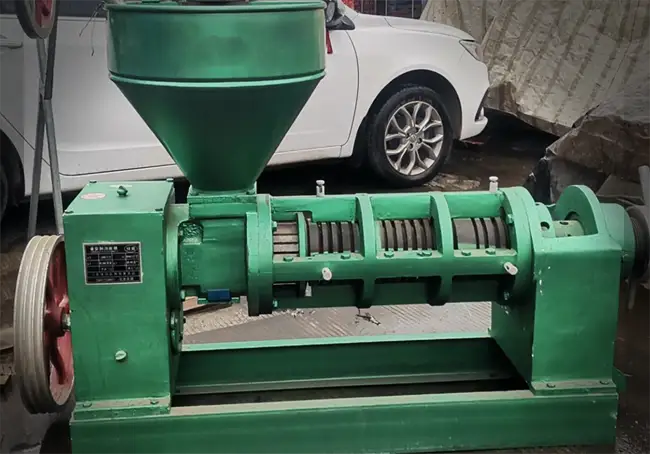
The working principle of a screw oil press.
In a screw press, pretreated seed or flakelike meal is fed into a barrel containing a turning screw. As material advances through narrowing geometry, pressure builds and oil is squeezed through barrel perforations. Because of motion and friction within the material, the heat is inevitable, especially in harder seeds or under heavier load.
The appeal of screw pressing is clear in practice: it supports continuous operation, can be tuned via screw design, cooling, feed rate, and allows decent throughput for many operations.
But it’s not 100% perfect. Even the best screw presses cannot drive residual oil down to zero. As mentioned earlier, this is a common problem with physical oil extraction. In normal operation, mechanical systems may slowly wear, like the screws, barrels and perforated parts can gradually degrade, especially when seeds include hard particles or dust. But, this is usually a routine maintenance factor, not a fatal flaw.
The pressing structure and pressing rod of the GQ-Agri screw oil press are made of high-hardness alloy steel, ensuring reliable operation for 5-10 years under proper use. For large-scale edible oil production plants, we customize solutions based on specific needs—equipping multiple oil presses or backup modules to avoid production interruptions. For most of my clients, the screw press remains the core: reliable, upgradeable and well able to balance throughput with simplicity.
Screw Oil Press that Can Operate Continuously for 24H:
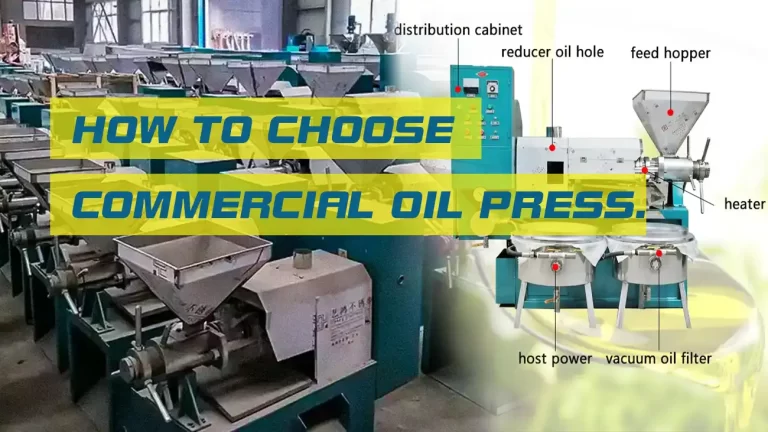
If you’re looking for reliable, continuous oil extraction, screw presses are your workhorse solution. These machines excel at processing high-volume operations, handling various oilseeds from sunflower to soybean with consistent performance. I’ve helped countless clients build profitable oil mills around screw press technology because it offers excellent cost-efficiency and straightforward operation. We’ll match you with the right model based on your daily processing capacity, raw material types, and production goals—whether you need a single machine or a complete automated production line.
Working principle of a hydraulic oil press.
Hydraulic pressing works unlike continuous screw. You load the meal or cake into molds or chambers, then apply static high pressure. Because there’s minimal internal motion, friction is reduced and heating is much less. This gentler pressing method helps preserve the natural aroma, color, and heat-sensitive nutrients (such as vitamins, phytosterols, and mono/polyunsaturated fatty acids) of crops, especially in high-end product lines.
That said, hydraulic presses inherently operate in cycles (like the “load → press → drain → unload”). That limits throughput. If your plant must handle tens or hundreds of tons a day, hydraulic may become a bottleneck unless you deploy many machines or large chambers. Our hydraulic oil presses feature precision-sealed, reliable hydraulic components and easy maintenance. This prevents seal failure or leakage that could compromise the integrity of the pressing pressure. In high-margin or boutique oils where flavor and purity matter, hydraulic presses often become the tool of choice for small batches or finishing lines.
When helping clients design or advise on oil pressing equipment, our sales representatives don’t use rigid checklists. They first consider the client’s daily output, business positioning, the plant’s daily operations, and the company’s equipment needs for the next few years. Furthermore, the layout of the production facility always allows for flexibility, such as space, piping, and utilities, to accommodate future upgrades or additions.
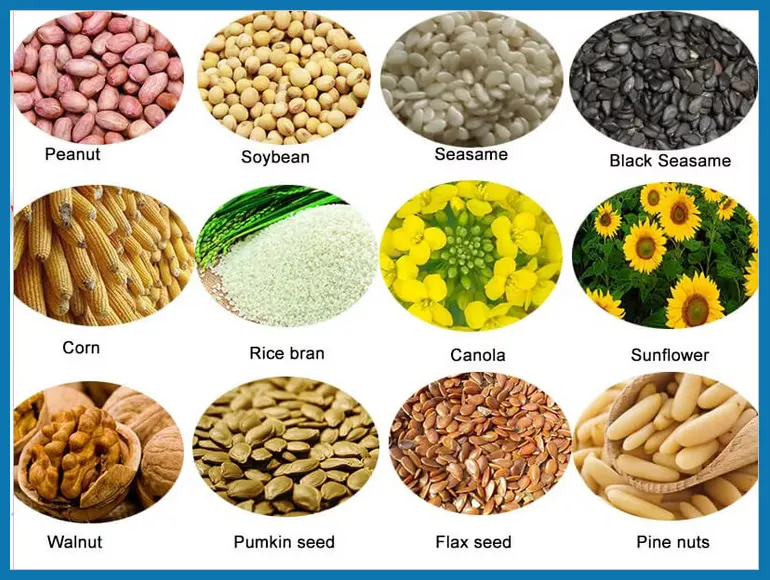
I often tell clients, “Use a high-performance screw press for your main output; reserve the hydraulic press for your high-quality virgin oil production line.” This way, you can achieve both efficiency and superior quality within the same plant.
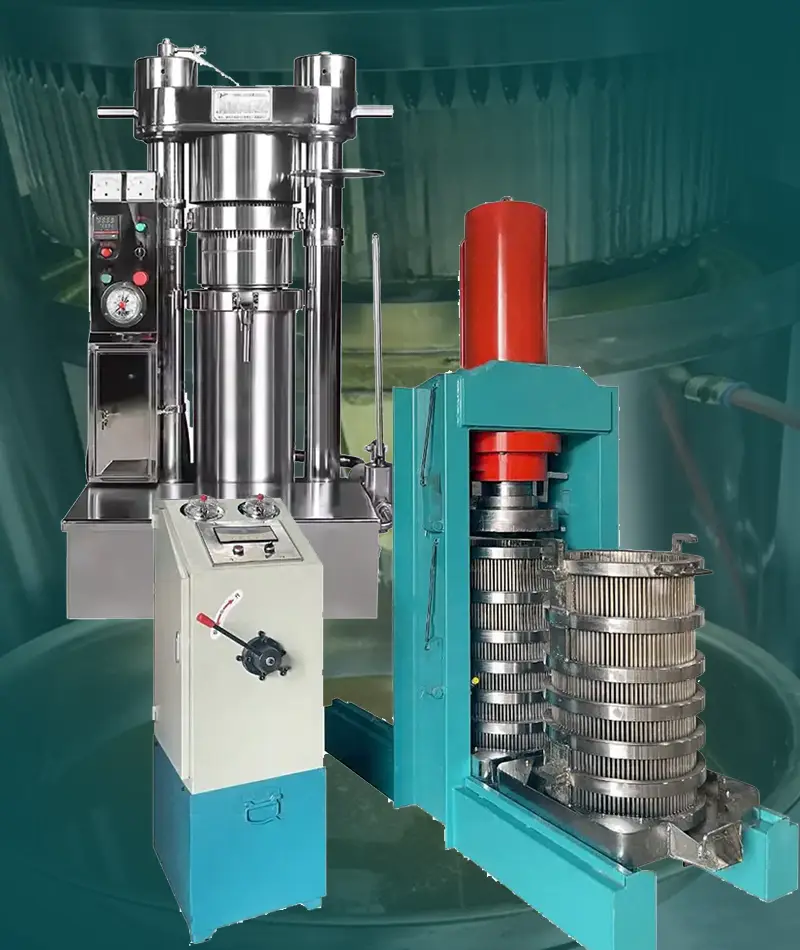
Low-temperature Cold-pressed Hydraulic Oil Press:
For those pursuing premium, cold-pressed oils with maximum nutritional value, hydraulic presses deliver unmatched quality. This gentle extraction method preserves delicate flavors, natural colors, and heat-sensitive nutrients that health-conscious customers demand. Perfect for specialty oils like avocado, walnut, or virgin olive oil, hydraulic pressing commands premium market prices. Let’s discuss your specific needs—from small-batch artisan production to mid-scale operations. I’ll recommend the optimal press capacity and supporting equipment to help you capture the growing premium oil market segment.
Are There Any Hybrid or Emerging Edible Oil Extraction Methods?
We don’t have to limit ourselves to just pressing or solvents. With proper selection and careful integration, we can incorporate new synergistic technologies into the core extraction process to improve oil yield or maintain quality.
When clients ask me if there are other ways to extend their business beyond pressing or solvent extraction, I suggest: first, identify the core process, then add auxiliary processes and equipment in a modular upgrade approach, rather than the other way around. With the development of technology, some niche assisted oil pressing methods have emerged this year: microwave-assisted extraction, ultrasonic-assisted extraction, pulsed electric field extraction, and cold plasma extraction. Through extensive research and field investigations, we have compiled information on the characteristics, applicable scenarios, and limitations of these emerging processes.
- Microwave-Assisted Extraction (MAE)
Microwaves penetrate materials, selectively heating water and polar molecules inside, so that internal energy helps rupture cell walls. That encourages oil to be released more readily. MAE is praised for shorter extraction times and improved yield compared with conventional methods.
Based on my observations, MAE functions best as a pretreatment before pressing or gentle solvent: you pre-heat/micro-disrupt the material so the core method captures more. But it has drawbacks: hotspots, uneven heating across a large batch, and limited uniformity can cause degradation or inconsistent performance at scale. - Ultrasonic-Assisted Extraction (UAE)
Ultrasound sends pressure waves into your material; cavitation bubbles form and collapse, creating micro-jets and shear stresses that help rupture cell walls and loosen oil pathways. Combining ultrasound with solvent extraction can improve oil yield.
I tend to treat UAE as a mild “booster”—not a primary method. Use it to shorten diffusion time or reduce residual oil. But be cautious about equipment durability, scale uniformity, and ensuring that every part of your material receives enough ultrasound exposure. - Pulsed Electric Field (PEF)
PEF is attractive because it’s largely non-thermal: you subject material to short, high-voltage pulses, creating micro-pores in membranes (electroporation). In olive oil extraction, applying PEF yielded 17% higher oil yields without degrading oil quality. In grape seed oil, PEF pretreatment increased yield by up to about 29.6% in one study, while preserving or enhancing phenolic and sterol content.
I often consider PEF my first candidate when modifying an existing pressing or solvent line, if your base process is stable, PEF can give a relatively clean bump. But the integration must be solid: electrode design, energy management, pulse control, and scaling constraints all matter. - Cold plasma extraction.
It’s an industry consensus that cold pressing yields low oil output. To improve this, high-energy electron-excited gas can now be used to generate low-temperature plasma that disrupts the cell walls of oilseeds (such as olives, peanuts, and rapeseed). This significantly increases oil yield and shortens pressing time at low temperatures, while preserving the active nutrients in the oil.
Implementing this new technology requires strict temperature control to prevent thermal denaturation of the oil, ensuring it’s processed at low temperatures to maximize the retention of unsaturated fatty acids and nutrients. Inert gases are used to prevent the oxidation of oils by active oxygen, and the pressed oil is stored at low temperature and away from light. However, this technology is currently in the early stages of research and industrial application, and is commonly used for processing high-oil crops such as peanuts. We believe it will soon be widely available to oil processing plants.
| Booster Method | Best Use | Key Benefit | Caution |
|---|---|---|---|
| MAE | As pretreatment | Faster extraction, helps rupture cells | Hotspots, uniformity issues |
| UAE | Assist to pressing / solvent | Boost yield, shorter time | Equipment wear, exposure control |
| PEF | Pretreatment stage | Nonthermal yield gain | Cost, integration complexity |
| Cold Plasma Extraction | As pretreatment | Utilizing low-temperature plasma to break down the cell walls of plant oilseeds, increasing oil yield. | Strictly control the processing temperature to prevent thermal denaturation of oils, which could affect unsaturated fatty acids and nutrients. |
When developing a plant design or evaluating a plan, I recommend against using all synergistic auxiliary processes simultaneously. Instead, select only one as an auxiliary (usually pulsed electric field or microwave-assisted extraction) and test it on a secondary production line. Monitor yield, quality, energy costs, and stability. If the results are satisfactory, scale up; otherwise, reduce investment.
Generally, I tell oil mill entrepreneurs: “Don’t try to patch up a weak core process with a lot of auxiliary processes; that will only lead to uncontrolled complexity.” Instead, use auxiliary processes to enhance existing effective processes. For example, you can use mechanical pressing to produce the main product while using pulsed electric field pretreated feedstock to produce high-end products. This provides multiple options without overcomplicating the process.
Which Edible Oil Extraction Method Is Right for Your Business?
There’s no one-size-fits-all answer! Over years of working with oil producers, I’ve developed an internal compass, and that is a way to sense which extraction method fits your unique context, rather than forcing one method to everyone.
When I sit with a founder, I don’t open with a checklist. I will imagine your daily rhythm: how many tons you aim to process, how tight your margin is, and what your brand story is. If your throughput is modest, going full-solvent from Day One is a gamble. If your brand emphasizes “pure, solvent-free, aroma-rich,” mechanical or gentle hybrid paths become more than a choice – they become boundaries.
Then I think of the hidden burdens: energy cost, maintenance, leak risk, safety systems. Some methods look great on paper but fail under those real-world weights. So I ask: is it better to accept slight yield loss now for simpler operations, or to squeeze every drop with more complexity? I also check regulation and consumer expectations (cause hexane is flagged in many markets). Finally, I imagine future growth: can your layout, piping, conduit allow boosters or finishing modules later—rather than forcing you to rebuild?
Beyond yield and purity, a few hidden technical variables also shape real performance.
Heat and friction inside screw presses quietly influence oil quality: localized hot spots can raise yield but reduce suitability for premium cold-pressed oils. High-end hydraulic systems avoid this through slow and steady pressure. And downstream refining adds its own weight – solvent-extracted oils typically need deeper degumming, neutralizing and deodorizing to meet food-grade standards. Those extra stages eat into some of the yield advantage gained upstream.
In making that judgment, a few key decision factors consistently emerge.
| Decision Factor | What You Should Ask |
|---|---|
| Scale / Throughput | How many tons per day or per year do you aim to process? |
| Product Positioning | Is your brand commodity, mid-tier, or premium / clean-label? |
| Investment Budget & Cost | What CAPEX / OPEX levels can you sustainably support? |
| Oil Quality & Sensory Goals | What residual oil, aroma, color, and nutrient retention must you meet? |
From dozens of projects, I’ve seen clear patterns emerge:
- In high-throughput operations, solvent or pre-press + solvent hybrid often becomes compelling, recovering residual oil can significantly lift margins.
But for mid-scale operations that value both volume and quality, I lean on a screw / expeller press as the core, while designing the system to allow bolting in mild boosters or finishing modules later. - When brand value centers on purity, aroma or “cold-pressed identity,” options like hydraulic pressing, enzymatic, or CO₂ extraction emerge as realistic paths.
- For small / artisan operations, sticking mechanical often offers the best control, lowest risk, and greatest flexibility.
These aren’t rigid rules. They’re alignment cues I use to help clients see what feels plausible.
For scale reference, below roughly 20 tons / day, mechanical pressing (with light pretreatment) is often the sweet spot – safe, compact and easy to control. Beyond 50-100 tons / day, solvent or hybrid lines start to justify their complexity as yield payback grows. If your brand highlights purity and minimal processing, stay mechanical or use gentle hybrid assists; if you are a large-scale producer of refined oil products, solvent efficiency often wins on economics.
If I were designing your plant, I’d still begin with a solid mechanical press foundation and keep space, utilities and tie-ins ready for modular upgrades. Start by operating a basic oil extraction production line to meet your current business needs, measuring yield, quality, and stability, and then scaling up as needed. That staged approach protects your investment and builds flexibility from the start. At GQ-Agri, that’s how we help clients grow: start practical, then evolve with proof.
Have questions about setting up an oil pressing production line?
Our team will help you plan your oil pressing facilities rationally.
Why do many plants use both pressing and solvent methods?
Yes, many oil plants use both because this combination is practical and efficient. Pressing removes a large portion of oil cost-effectively, while solvent finishing extracts the remaining oil from the press cake. In many commercial setups, combining them lowers residual oil to below 1 %.
Is solvent extraction safe in edible oil production?
Yes, it is safe when well designed and controlled. Well-engineered recovery, distillation and emission systems can ensure residual solvent levels stay within food-grade limits. But, the hexane is classified as a hazardous air pollutant in so many regions, so strict handling and safety standards are required.
What residual oil rates can pressing vs solvent achieve?
Solvent extraction achieves lower residual oil levels. Mechanical pressing often leaves about 5–8 % residual oil, while solvent finishing in industrial plants can reduce this to below 1 %.
Does pressing preserve more natural flavor / nutrients?
Yes, pressing generally retains more natural compounds. Since it avoids chemical solvents and high-temperature refining, more aroma, pigments, and antioxidants are preserved.
Which method suits small or boutique producers best?
Mechanical pressing fits many small and boutique producers best. It’s simpler, safer and aligns perfectly with the “solvent-free” or “natural” branding. The system is much easier to maintain, scale gradually and helps protect both quality and brand integrity.